
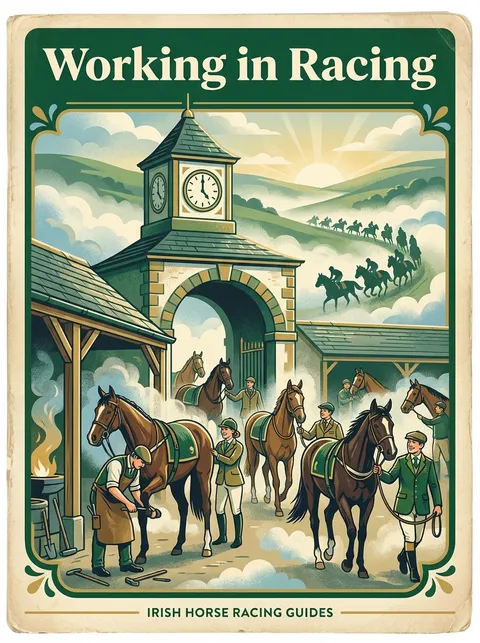
Behind every race day is a small army of people: stable staff who are up before dawn, work riders, travelling head lads and lasses, farriers, vets, racecourse teams and many more. Irish racing is worth around €1 billion a year and employs over 14,000 people, and there are routes in whether you grew up on a farm or have never sat on a horse.
If you are ready to look for work now, head straight to our racing jobs board.
The main jobs in a racing yard
Stable staff
The backbone of every training yard. Day to day the work typically includes mucking out, grooming, feeding, tacking up, leading horses to and from the gallops, and keeping a close eye on each horse's health so that any heat, swelling or lameness is spotted early. Days start early, and weekends and bank holidays are often working days because that is when racing happens.
Riding out (work riders)
Experienced riders exercise the horses on the gallops each morning. It is skilled, physical work and one of the best-loved jobs in racing. Most people start as stable staff and progress to riding out as their skills grow.
Travelling staff
Travelling head lads and lasses take horses to the races, look after them on the day and lead them up in the parade ring. It is a great way to see every racecourse in the country.
Jockeys
Most jockeys start young, often through pony racing or point-to-point, and join a yard as an apprentice (Flat) or conditional (jumps) rider. Jockeys are licensed by the Irish Horseracing Regulatory Board (IHRB). It is a demanding career with strict weight limits and real physical risk, but the rewards for those who make it are huge.
Beyond the yard
Racing also needs farriers, vets and veterinary nurses, stud staff, racecourse managers, groundstaff, caterers, marketing and media people, bloodstock agents and administrators. Horse Racing Ireland, the IHRB and the racecourses all recruit for office and specialist roles.
Training at RACE
The Racing Academy and Centre of Education (RACE) in Kildare is the national training academy for Irish racing. It was set up in 1973 to support young racing apprentices and sits on the edge of the Curragh training grounds, on the former Tully estate that is now home to the Irish National Stud.
RACE has trained many well-known riders, including Johnny Murtagh, Seamie Heffernan, Chris Hayes, Cathy Gannon, Daryl Jacob and Brian Hughes. Its funding comes from Horse Racing Ireland, the Kildare and Wicklow Education and Training Board, and a share of racing prize money.
The academy went through a difficult period in 2023, when its residential buildings closed for safety reasons and a large number of staff were made redundant. Its courses are now non-residential. As of 2025 it offers:
- A six-week jockey preparation course, followed by a six-week placement with a trainer
- Shorter courses in equine nutrition, transport, schooling and administration
Course dates and entry requirements change, so contact RACE directly for the current programme.
Pay and conditions
Pay varies by role, experience and employer, and published industry rates date quickly, so we do not quote figures here. What you can check:
- Minimum standards. All employees in Ireland are covered by national employment law, including the national minimum wage and working time rules. Horse Racing Ireland has produced an employment guide for the racing and breeding industry with the Workplace Relations Commission, setting out good practice.
- Pension. Irish racing runs a Stable Employees Defined Contribution Pension Scheme for people who work for licensed trainers.
- Representation. The Irish Stable Staff Association represents stable employees.
- Accommodation. Some yards offer accommodation, which can make a big difference in rural areas. Ask at interview.
When you are offered a job, ask about hours, days off, riding opportunities, accommodation and how often you would travel to the races.
Where the work is
Training yards are spread right across the country, but Co. Kildare is the traditional heartland, with the famous training grounds beside the Curragh, where RACE is also based. Racecourses need extra staff at festival time, such as the Galway Races and the Punchestown Festival, which can be a good way to get a taste of the industry.
How to get started
- Get some experience with horses. Riding lessons, a local livery yard, pony club or volunteering with a horse charity all help.
- Go racing. Watching the staff at work in the parade ring and stable areas gives you a feel for the job. Our first day at the races guide has the basics.
- Look into RACE. Its courses are designed to bridge the gap between enthusiasm and employment.
- Apply directly. Browse our jobs board and do not be shy about contacting trainers.
- Be reliable. In a racing yard, turning up on time every morning matters more than almost anything else.
Other ways to be involved
Not everyone who loves racing wants to work in it full time. You might prefer to share in a racehorse through a syndicate or club, or give a former racehorse a new career. Our guide to buying a retired racehorse and the horses listed on our marketplace are a good place to start.
Questions people ask
Do I need experience to work in a racing yard?
Some experience with horses helps a lot, but many trainers will teach keen, reliable newcomers on the job. Courses at RACE in Kildare are designed to help people make the move into the industry.
What is RACE?
The Racing Academy and Centre of Education in Kildare, founded in 1973, is the national training academy for Irish racing. As of 2025 it runs a six-week jockey preparation course with a six-week trainer placement, plus shorter equine courses.
How many people work in Irish racing?
Irish racing employs over 14,000 people, across training yards, stud farms, racecourses and support services.
How much do stable staff earn in Ireland?
Pay depends on the role, experience and employer, and published rates date quickly. All employees are covered by Irish employment law, and licensed trainers' staff can qualify for the industry pension scheme. Ask for full details of pay, hours and accommodation before accepting a job.
Sources
- Wikipedia: Racing Academy and Centre of Education
- Wikipedia: Horse racing in Ireland
- The Irish Field: Industry personnel urged to read employment guide
- IHRB: Stable Employees Defined Contribution Pension Scheme (ROI) vacancy
- Kildare Now: RACE academy redundancies
Last reviewed 30 September 2026. Dates and details change, so check with the racecourse before you travel.