
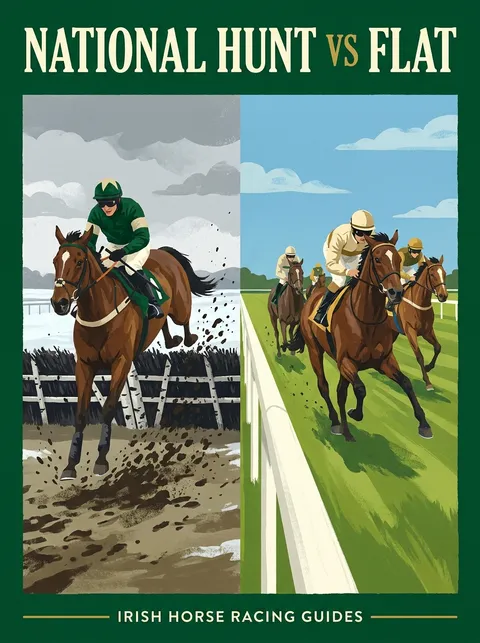
If you have ever wondered why some races have fences and some do not, or why the Galway Races has both, this is for you. Horse racing in Ireland is split into two codes: Flat racing and National Hunt racing, also known as jump racing. Of Ireland's 26 racecourses, 23 stage both, so many meetings, and several festivals, give you a taste of each.
Flat racing
In Flat racing, horses race over a set distance with no obstacles. It is all about speed, balance and timing.
- Distances. Irish Flat races range from 5 furlongs to 20 furlongs (a furlong is an eighth of a mile, about 201 metres). Short races are called sprints, and long ones are staying races.
- Starting stalls. Flat races start from stalls, so the whole field breaks together.
- The horses. Flat horses are often raced young, from two years old, and the best colts and fillies can go on to valuable breeding careers.
- The season. The turf Flat season usually runs from around mid-March to mid-November. Outside that, Flat racing continues under floodlights on the all-weather track at Dundalk.
The Irish Classics
The high points of the Flat year are the five Irish Classics, all run at the Curragh in Co. Kildare:
- Irish 2,000 Guineas: May, 1 mile
- Irish 1,000 Guineas: May, 1 mile
- Irish Derby: late June or early July, 1 mile 4 furlongs
- Irish Oaks: July, 1 mile 4 furlongs
- Irish St Leger: September, 1 mile 6 furlongs
The Irish St Leger is unusual: unlike its British counterpart, it is open to horses older than three, and it is the only Irish or British Classic open to geldings.
Big Flat festivals include the Irish Derby Festival and the Irish Champions Festival at Leopardstown and the Curragh each September.
National Hunt (jump) racing
National Hunt racing asks horses to jump as well as gallop, and it has deep roots in Ireland. The sport grew out of Irish cross-country "pounding races" in the early 18th century, where riders raced across open country over whatever obstacles lay in the way.
There are three main types of National Hunt race.
Steeplechases (chases)
The biggest obstacles. Chase fences are at least 4.5 feet high, and courses can include open ditches and water jumps. Races run from about 2 miles to 4.5 miles. The Irish Grand National at Fairyhouse on Easter Monday is the most famous Irish chase, and the richest race in the Irish jumps calendar. See the Fairyhouse Easter Festival guide.
Hurdles
Hurdles are smaller and more flexible than chase fences, at least 3.5 feet high, and races run from about 2 miles to 3.5 miles. Young jumpers usually start over hurdles before moving on to fences.
National Hunt Flat races (bumpers)
Confusingly, these are jump-racing races without any jumps. Bumpers run over roughly 1.5 to 2.5 miles and give young horses bred for jumping their first experience of the racecourse before they tackle obstacles.
Point-to-point
Beneath the professional sport sits point-to-point, amateur jump racing usually over about three miles of farmland. Ireland stages more than 100 point-to-point meetings a year, and they are where many future stars first appear.
The jumps horse and season
Most National Hunt horses are geldings, so they have no breeding value and can race for many seasons, which is why jumps fans get to follow the same horses year after year. The jumps season in Ireland runs all year but peaks from November to April, when softer ground makes jumping safer for the horses.
The big National Hunt festivals are the Leopardstown Christmas Festival, the Dublin Racing Festival in February, the Fairyhouse Easter Festival and the Punchestown Festival in late April.
Mixed festivals
Some of Ireland's best-loved festivals mix both codes. The Galway Races have Flat and jump races across seven days, with the Galway Plate (a chase) and the Galway Hurdle as the features. The Listowel Harvest Festival in September and Killarney's summer festivals also combine the two.
Quick comparison
- Obstacles: none on the Flat; hurdles or fences over jumps (none in bumpers)
- Peak season: spring to autumn for the Flat; November to April for jumps
- Typical distances: 5 to 20 furlongs on the Flat; about 1.5 to 4.5 miles over jumps
- Horses: Flat horses are often young, and the best colts and fillies may go to stud; jumpers are often older and mostly geldings
- Headline races: the Irish Derby and Irish Champion Stakes on the Flat; the Irish Grand National and Galway Plate over jumps
Which should I see first?
Both are brilliant in their own way. Flat racing on a summer evening is relaxed and fast, while a winter jumps meeting has a raw excitement all of its own. If you cannot decide, go to a mixed festival. Our first day at the races guide and Irish racing calendar will help you pick a day.
If you are interested in what happens to horses after racing, many former jumpers and Flat horses go on to new careers. See our guide to buying a retired racehorse.
Questions people ask
What is the difference between National Hunt and Flat racing?
Flat races have no obstacles and focus on speed over 5 to 20 furlongs. National Hunt races are jump races over hurdles or steeplechase fences, usually over longer distances, plus bumpers that have no jumps.
What is a bumper?
A National Hunt Flat race, run over roughly 1.5 to 2.5 miles with no obstacles. It gives young horses bred for jumping their first racecourse experience.
When is the National Hunt season in Ireland?
Jump racing takes place all year in Ireland but peaks from November to April, when the ground is softer.
Where are the Irish Classics run?
All five Irish Classics, the 1,000 Guineas, 2,000 Guineas, Derby, Oaks and St Leger, are run at the Curragh in Co. Kildare.
Sources
- Wikipedia: Horse racing in Ireland
- Wikipedia: National Hunt racing
- Wikipedia: Flat racing
- Wikipedia: Irish Classic Races
- Wikipedia: Galway Races
- Horse Racing Ireland: Fairyhouse Easter Festival, all you need to know
- Wikipedia: Leopardstown Racecourse
- Wikipedia: Listowel Racecourse
Last reviewed 30 September 2026. Dates and details change, so check with the racecourse before you travel.